


First time floating: what to actually expect
First time floating: what to actually expect
The most-asked question about floatation
The most common question we get asked at being is some version of this: “But what do you actually do in there?”
Honest answer: nothing. That’s the whole point.
You lie back in skin-temperature water that’s so dense with Epsom salt you float on the surface without trying. The lights go down. The world outside stops mattering for an hour. And somewhere between “this is weird” and “I’ve never been this calm in my life,” something shifts.
If you’re booked in for your first float, or thinking about it, here’s what actually happens. No spa-brochure fluff.
How to prepare for your first float
A few small things make a real difference.
Avoid coffee in the hour before
Caffeine winds up the nervous system you’re about to spend an hour calming down. If you’re a four-coffees-a-day person, this is the one rule worth respecting.
Hydrate through the day
You’ll be in warm, salty water for an hour. Hydration helps the float itself feel good and helps you feel even better afterwards.
Don’t shave that day
Freshly shaved skin will sting in the salt water. You’ll know about it within ten seconds of getting in.
Eat something light an hour or two before
Not empty-stomach, not full-stomach. You don’t want hunger pulling you out of the moment, and a heavy meal sitting under you isn’t comfortable either.
Don’t bring anything
Towels, earplugs, body wash and shampoo are all provided. If you wear contact lenses, bring a case to take them out before you float — salt water and contacts don’t mix.
Arriving at being
You walk in, take your shoes off, and someone shows you to the lounge. There’s water, herbal tea, and a few minutes to settle. If it’s your first time, we’ll walk you through everything before you go through to your float room. No surprises.
The float rooms aren’t pods. This matters. Most of what you’ve seen online is people climbing into something coffin-shaped, which is fine if you like that, but it puts a lot of people off before they’ve even started.
At being, you walk into a private room with a small open pool. A bit bigger than a single bed, deep enough to float in comfortably, no lid. You can sit at the edge first if you want. You can leave the lights on a dim glow rather than total darkness. The door’s never locked. You’re in charge of how it feels.
The pre-float shower (yes, it’s mandatory)
Showering before your float is mandatory, and it’s not us being precious. It does two things at once: it keeps the water clean for the next person, and it strips off the day’s oils, lotions and product residue so the water around you stays calm and chemistry-neutral.
You shower again after. We’ll come back to that.
Getting in the float pool
Pop your earplugs in before you get near the water. Once they’re in, salt won’t get into your ear canals, which is the only thing that genuinely lingers afterwards if you forget.
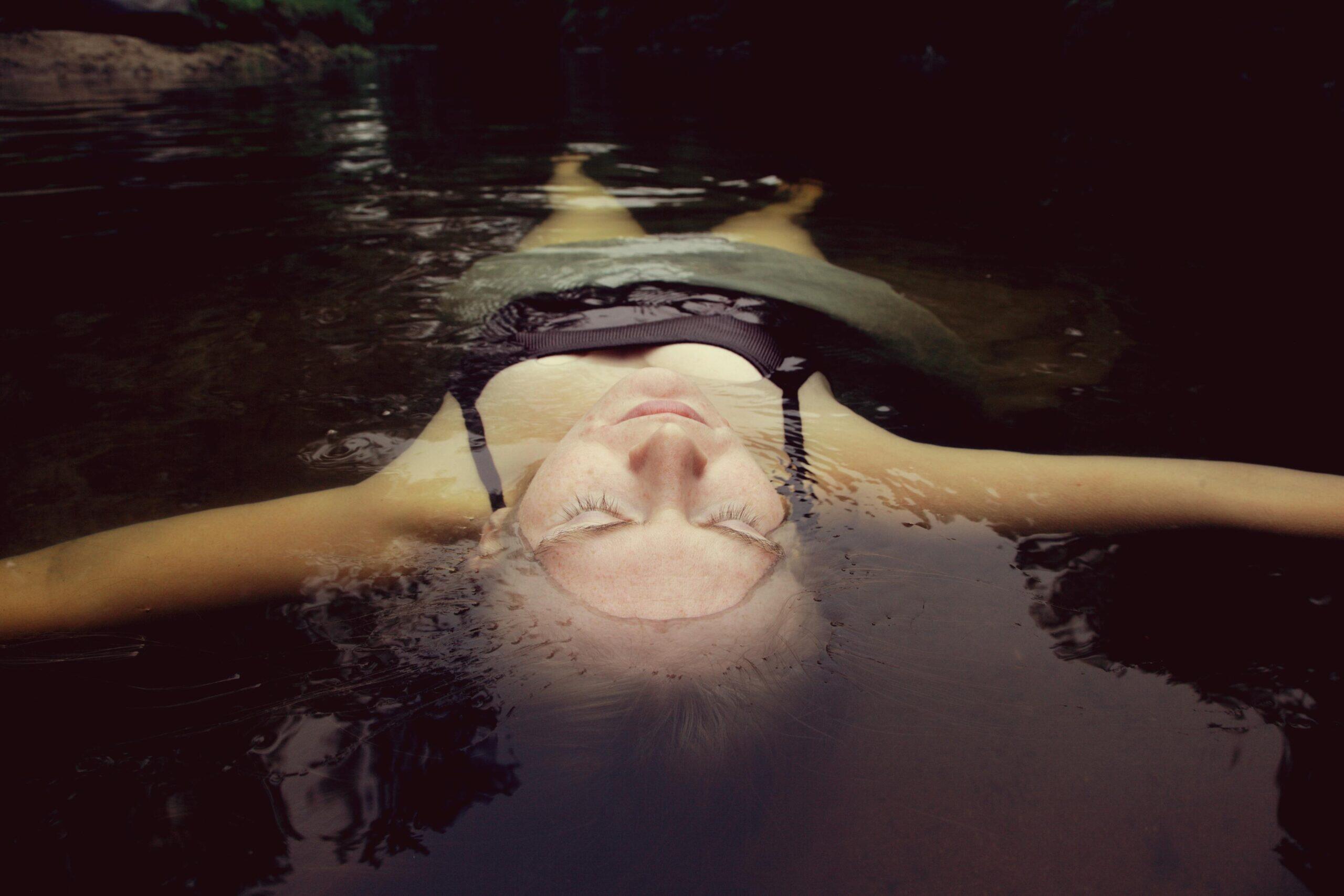
You step into the pool and lie back. The water sits at skin temperature, around 35°C, so once you’re settled you stop being able to feel where the water ends and your skin starts. It’s denser than the Dead Sea, around 30% salt by saturation. You don’t have to do anything. Lifting yourself out takes effort. Sinking is impossible.
The first sensation is usually a tiny shock at how easy it is. People expect to have to balance. They don’t. Your body is held.
What happens in the first ten minutes
This is the bit nobody warns you about, so we will: your brain doesn’t shut up immediately.
The first ten minutes are usually the noisiest. You’ll notice every itch, every place your shoulders are tight, every random thought. You might shift around looking for the “right” position. There isn’t one. Arms above your head, arms by your sides, both work. Whatever lets your shoulders drop.
You might catch yourself thinking, “Am I doing this right?” You are. Doing nothing is doing it right.
The trick is to stop trying. The float doesn’t need your help.
The middle stretch (where it gets interesting)
Somewhere between minute 15 and minute 25, something changes.
Your body stops feeding your brain its usual reports. No pressure on the joints, no temperature gradient, no sound, no light. With nothing to track, the brain starts to let go. People describe this part very differently. Some say their body seems to disappear. Some say the edges of where their skin ends and the water starts blur completely. Some get a kind of waking quietness they’ve never felt anywhere else. Some fall asleep. More on that in a second.
Time stops behaving normally. An hour can feel like fifteen minutes or like three hours. Both are normal.
If you’ve never properly switched off, if your nervous system runs a permanent low hum of stress in the background, this middle stretch is where you might realise, possibly for the first time in a long time, what its absence feels like.
How the session ends
You don’t have to watch the clock. The room signals the end of your session, usually with a gentle change in lighting, sometimes with soft music fading in. You’ll know.
Don’t leap up. Sit at the edge of the pool for a minute. Your inner ear has been resting in salt water for an hour and your sense of balance can be a little hazy for the first thirty seconds. Stand up slowly.
The post-float window
Shower again, properly this time. Salt clings to skin and hair, and you’ll thank yourself later for taking your time rinsing it all off. Conditioner is your friend.
There’s water and somewhere quiet to sit afterwards. We genuinely recommend you take it. The first 20 to 30 minutes after a float — what regulars call the “float afterglow” — is its own thing. Calm without being foggy. Clear-headed without being wired. A lot of people describe it as the most settled they’ve felt all week.
Don’t book a stressful meeting straight after if you can help it. Don’t drive immediately if you feel spacey. Give it a few minutes.
Getting the most from your first float
A few things that genuinely help.
Let go of expectations
You might have a transcendent hour. You might just have a quiet, comfortable rest. Both count. The float doesn’t owe you a particular experience.
Don’t try to “do it right”
There’s no technique. Your body knows how to lie still in warm salty water.
Give it more than one go
Most people’s second float is significantly better than their first, because the first half-hour of the first one tends to be spent learning the room. By session two or three, you drop in much faster. We see this every week.
Notice the rest of the day
A lot of what makes floating valuable shows up in the next 24 hours: better sleep that night, less mental noise the next morning. Pay attention to it.
Ready to try
If you’ve read this and you’re still curious, that’s usually a sign you should book one in. The thing nobody can tell you on a website is what an hour of genuine quiet feels like. You have to experience it.
Book your first float at being — open pool, private room, no pods, no pressure.
We’ll see you in the lounge.
FAQs
What if I fall asleep during a float?
Sometimes you will. The water is so dense you can’t roll over, and your face stays well clear of the surface even if you drift off. Falling asleep in a float is safe and very common. Your body is telling you it needs the rest.
Can I get out mid-float if I need to?
Yes, any time. The door isn’t locked. There’s no one timing you against your will. If it’s not for you on the day, you stop. We won’t take it personally, and most people who feel that on the first session are completely fine on the second.
Is the water actually clean?
Cleaner than a swimming pool, by a long way. The water is fully filtered between every session, and the salt concentration is high enough that almost no microorganism can survive in it. The mandatory pre-float shower is a real layer of that hygiene.
Will I feel claustrophobic in a float?
This is the single biggest reason people put off trying. The reason we built our float rooms as open pools rather than pods is exactly this. You’re in a private room with space around you and no lid over your head. You can sit up. You can stand up. You can leave the lights on a dim glow. If you’ve avoided floating because of pods, this is genuinely a different experience.
How long is a float session?
60 minutes in the pool, plus around 30 minutes either side for showering, settling and the afterglow. Plan for around 90 minutes for the visit. If you’re combining with a massage or sauna, allow another hour.
What do I wear in a float?
The room is private, so the choice is yours. Most guests float without swimwear because anything you wear can press into the skin under buoyancy and become uncomfortable.
How often should I float for best results?
Most regulars float every two to four weeks. You’ll feel something from your first session — usually a deeper sleep that night and a calmer head the next day. The compounding benefits (stress, recovery, sleep quality) tend to show up after three or four floats spaced a few weeks apart.